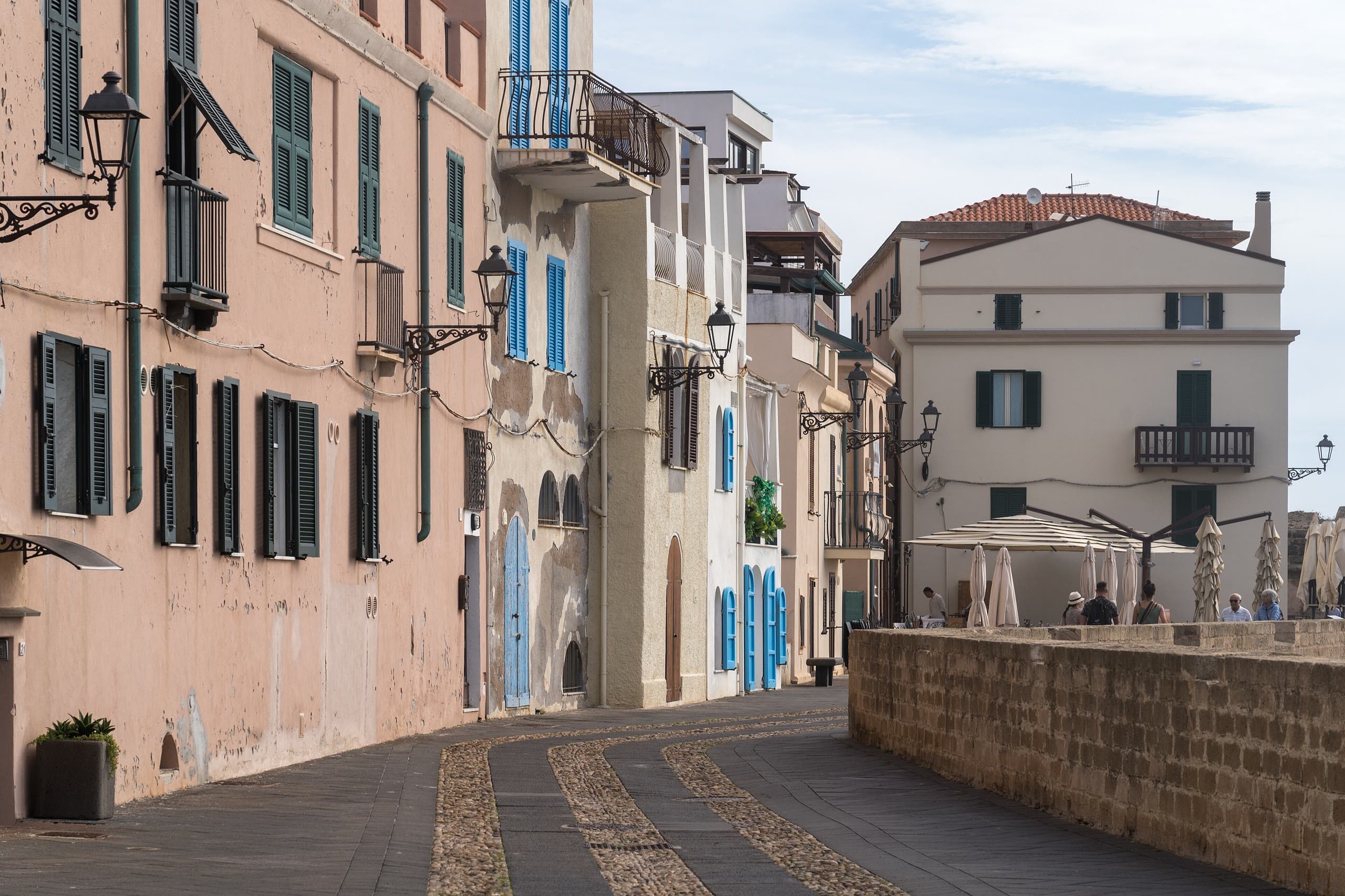
A street inside Alghero's old town running along the sea walls: pink and cream façades with green and blue shutters, wrought-iron lamps, and the stone parapet of the bastion on the right.

AlgheroPrices · Preus

What Alghero costs

Preus · 40.56° N 8.32° E

A city bus ticket costs one euro. An umbrella and two sunbeds on the town beach for a week in August cost about two hundred and seventy. Everything you will spend here sits between those two numbers. This page lists the ranges — getting here, sleeping, eating, tickets — and says which of them come from a published tariff and which are what the market charges.

Photo Alexkom000 / Wikimedia Commons, CC BY 4.0

A day in Alghero, three ways

  • Budget€60Bed €24. Food €22. Getting around €6. Tickets €8.
  • Mid-range€130Bed €56. Food €45. Getting around €17. Tickets €12.
  • Comfortable€260Bed €140. Food €78. Getting around €26. Tickets €16.

BedFoodGetting aroundTickets

Per person per day, with two people sharing a room and a car. Built from the ranges below: the bed includes the tourist tax, the food assumes one meal out a day. August lifts every bar, and almost all of the rise lands on the first segment.

Getting here

Reaching the island, then moving around it

The flight is the part you can influence most and the part we can promise least about. Everything after it — the bus from the airport, the taxi, the parking meter — runs on a published tariff.

Return flight from mainland EuropeLow-cost carriers serve Alghero from most of Europe. Late autumn to spring sits at the bottom of this range, the first half of August at the top.
€60 – €300
Ferry to Sardinia, deck seatOne way into Porto Torres, 36 km from Alghero. Genoa, Civitavecchia and Barcelona all sail there.
€35 – €110
Car on the ferryOne way, on top of every passenger fare. A camper costs more again.
€85 – €260
Inside cabin, two to four berthsOne way. The overnight crossing from Genoa takes about twelve hours.
€65 – €180
Airport bus into town, line 3Bought before boarding; €1.50 from the driver. Contactless on board costs the same as a ticket.
€1/ ride
Taxi from the airport, minimum fareTen kilometres to the walls. Inside town the minimum is €8.
€18
Taxi, flag fallThen €2 per kilometre up to ten, €1.60 beyond. Nights and public holidays cost more.
€4
Train or bus to SassariAbout 41 minutes on the ARST narrow-gauge line, roughly twenty runs a day. Buy before boarding: on the train the fare carries a surcharge.
€3
Small car for a week in AugustAlghero is one of the dearest places in Italy to hire a car — Federconsumatori priced the same week here well above the national average. Out of season it falls far below this.
€500 – €930/ week
Petrol, self serviceThe national weekly average. Diesel runs about ten cents more.
€2.05/ litre
Blue-line parkingPaid around the clock in the central zone from 15 April to 15 October. The multi-storey on piazza dei Mercati charges the same rate.
€0.50/ hour
Motorway tolls in SardiniaThere are none. The island has no motorways at all; the SS 131 spine road is free.
€0

SourcesARSTComune di AlgheroOsservaprezzi carburanti (MIMIT)Federconsumatori

Prices checked September 5, 2026

Sleeping

A bed, per night

The season decides this more than the star rating. The same double room can move by a factor of three between February and the first half of August, which is why these ranges are so wide.

Pitch for two at a campsiteTent or camper. Several sites sit along the pine belt north of town.
€25 – €60/ night
Bed in a shared roomPer person. Alghero has few hostel beds, so they go early in summer.
€25 – €45/ night
B&B, double roomThe bottom of the range is November to March, the top is the first half of August.
€60 – €250/ night
Apartment for two to fourWeekly bookings are the norm in July and August; nightly rates are easier to find outside them.
€70 – €260/ night
Three-star hotel, double roomBreakfast usually included.
€80 – €220/ night
Four-star hotel, double roomSea-front rooms sit at the top of the range.
€130 – €380/ night
Agriturismo outside townOften with dinner. You need a car to reach them.
€80 – €190/ night
Tourist tax, four stars and aboveCharged by the property on top of the room rate, since 1 January 2026.
€4/ person / night
Tourist tax, up to three stars and rentalsThe same rate for B&Bs, apartments and agriturismi.
€2/ person / night
Tourist tax, campsite with your own vehicleCharged for at most seven consecutive nights. Children under twelve pay nothing.
€1/ person / night

SourcesComune di Alghero — imposta di soggiorno

Prices checked September 5, 2026

Eating and shopping

Bar, restaurant, supermarket

Two Italian habits shape the bill more than the menu does: coffee costs less standing at the counter than sitting at a table, and every restaurant adds a cover charge per person.

Espresso at the counterThe Italian average is €1.29. A table on a square costs more for the same cup.
€1.20 – €1.60
Cappuccino and a pastryThe standard Italian breakfast, taken standing at the bar.
€3 – €5
Pizza margheritaThe Italian average is €7.04, and the south of the country sits below the north.
€6 – €9
Fregola or pasta, first courseFregola with clams is the local one.
€12 – €18
Fish or seafood, main coursePriced by the plate. Whole fish is sold by weight, so ask before it is cooked.
€18 – €35
Aragosta alla catalanaThe town's signature dish, sold by the kilo at the price of the day and usually shared by two. Sardinian lobster fishing is closed from September to the end of February.
€80 – €140/ kg
Set or tasting menuCommon in the old town in summer.
€20 – €45
Coperto, the cover chargePer person, printed on the menu and added to every restaurant bill in Italy. It is not a tip.
€1.50 – €3.00
Half a litre of house wineA bottle of local Vermentino starts at around €15 in a restaurant.
€6 – €12
Beer, 0.4 lIchnusa is the Sardinian one, brewed on the island since 1912.
€4 – €6
Gelato, two scoopsSmall cone or cup. Larger sizes and seafront counters go above this.
€3 – €5
A day's shopping for twoSupermarket basket, cooking for yourself. This is where Italy is cheaper than Greece or Croatia — see the comparison below.
€20 – €35/ day

SourcesCRC / Assoutenti — prezzo del caffèOsservatorio della pizza napoletana

Prices checked September 5, 2026

Seeing things

Tickets and activities

The museums and the archaeological sites publish one tariff and stick to it. Boats, dives and rentals set their own, so those are ranges — the figures here are what operators in Alghero were charging when we checked.

Neptune's Grotto, entry€10 reduced for ages 6–17, students under 26 and Alghero residents; under-sixes free. Neither the boat nor the shuttle bus is included.
€18
Boat to the grotto and backFrom the port, about 40 minutes each way, spring to autumn. Children aged 3–12 pay €8. Cancelled when the sea is rough.
€16
Coral Museum or Archaeological Museum€5 reduced. Both are in town, a few minutes apart.
€7
Nuraghe Palmavera or Anghelu Ruju€5 reduced. A guided visit taking in both sites costs €12.
€7
Alghero Ticket, thirteen sitesCovers the grotto, both museums, the archaeological sites and the Porto Conte park. €70 for two adults and three under-18s.
€35
Coastal boat trip with a swim stopHalf a day along the Coral Riviera. Lunch is sometimes included, sometimes extra.
€40 – €80
Single dive with equipmentTwo dives in one day cost €110. Most of the coast west of town lies inside the marine protected area.
€55
Kayak or paddleboard, half a dayGuided trips cost more than bare rental.
€25 – €45
Town bike for a dayAn e-bike costs two to three times as much.
€8 – €20/ day
Umbrella and two sunbeds, one dayOnly at a lido. The sand itself is public, and free.
€25 – €50/ day
Umbrella and two sunbeds, a week in AugustAltroconsumo priced 222 Italian lidos in the week of 2–8 August 2026, front row to fourth. Alghero came third dearest in the country, behind Alassio and Gallipoli, and 14% above its own 2025 prices.
€248 – €288/ week

SourcesGrotta di NettunoMusei di AlgheroNavisardaAlghero DiversAltroconsumo — spiagge 2026

Prices checked September 5, 2026

Costing nothing

What you do not pay for

Worth knowing before you budget: the three things Alghero is best known for — the walls, the old town and the sand — are all free to walk into.

The beachesThe sand is public. You pay a lido for a serviced spot, and a car park in summer, but never for the beach itself.
€0
The sea walls and the old townThe bastions are a public promenade, open day and night. Nothing inside the walls is ticketed.
€0
The cathedral and the old-town churchesThe naves are free. The bell tower and the museum inside the San Francesco complex are not.
€0
Tap waterDrinkable, with street fountains around town. A restaurant will still sell you a bottle.
€0
The cycle path to FertiliaFive kilometres along the seafront, flat the whole way. Only the bike costs anything.
€0
Processions and festivalsSetmana Santa, the summer calendar, the autumn saints' days — all free to watch.
€0

Prices checked September 5, 2026

Compared

Cheaper than France, dearer than Spain

Eurostat prices the same basket in every European country once a year and sets the EU average at 100. Two of its categories decide most of a holiday budget: what you pay to eat out and sleep, and what you pay in a shop.

  • France116.0106.8
  • Italy110.8101.1
  • Malta91.4112.9
  • Croatia89.6105.5
  • Greece86.1105.3
  • Spain85.495.3
  • Portugal73.6102.0

Italy runs about eleven per cent above the EU average for restaurants and hotels, and roughly thirty per cent above Spain or Greece — that is the real gap between Sardinia and the other big island holidays. Groceries reverse it: Italian shops are cheaper than Greek or Croatian ones. So a week where you cook half your meals costs much what it would in Greece, and a week of restaurants does not. These are national figures, and a resort coast always sits above its own country's average.

SourcesEurostat — price level indices, 2025

Questions

Before you book

Is Alghero expensive?

Against Spain or Greece, expect to pay about a third more for restaurants and hotels and slightly less in a supermarket. Within Italy it behaves like what it is — a summer resort — so the season matters more than the town: the same double room can cost three times as much in the first half of August as it does in February.

When is it cheapest to come?

Late April to early June, and the second half of September. The sea is usable, everything is open, and a bed costs roughly half the August rate. November to March is cheaper again, but many seaside places close for the winter and the boat to Neptune's Grotto does not run.

Do I need a car, and is it worth the money?

Not for the town: the old town is closed to traffic and small enough to cross on foot in five minutes, and city buses cost a euro. A week's hire in August can cost more than two flights. If you want Capo Caccia, the northern beaches or Bosa, you need either the car or an organised trip — that is the calculation to make before you book one.

Card or cash?

Cards work almost everywhere, including on city buses, where contactless has been accepted since June 2026. Parking meters take cards too, and the EasyPark and DropTicket apps work at them. Keep some cash for beach kiosks and small bars.

What is the coperto on my bill?

A per-person cover charge, between €1.50 and €3, printed on the menu and added to every restaurant bill in Italy. It covers bread, linen and table service. It is not a tip, and tipping on top is not expected — rounding up is enough.

Do I have to pay for a sunbed?

No. The sand is public and you can lay a towel on it. A lido sells you an umbrella, sunbeds and usually a shower and a bar — which in Alghero is one of the more expensive versions of that in Italy, so it is worth knowing it is optional.

How much is the tourist tax and who collects it?

Two euro per person per night in most places, four in hotels of four stars and above, one at a campsite with your own vehicle. It is charged for at most seven consecutive nights, children under twelve are exempt, and the property collects it — usually at check-out, often in cash.